Techno Press


Home
Editors-in-Chief
    Prof. Enrico Drioli (European Ed.)
    Dept. of Chemical Eng. & Materials
    University of Calabria, Italy
    Dr. Young Chul Choi (American Ed.)
    Director R&D
    Doosan Hydro Technology, USA
    Prof. Ruey-Shin Juang (Asia-Pacific Ed.)
    Dept. of Chemical Eng. and Materials Science
    Yuan Ze University, Taiwan
Managing Editor
    Prof. Chang-Koon Choi
    Dept. of Civil & Environmental Engineering
    Korea Advanced Institute of Science & Technology, Korea

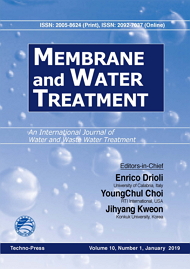
ISSN: 2005-8624(Print), ISSN: 2092-7037(Online)
Vol 4(4 issues) for 2013, Quarterly
Aims and Scope
The Membrane Water Treatment(MWT), An International Journal, aims at opening an access to the valuable source of technical information and providing an excellent publication channel for the global community of researchers in Membrane and Water Treatment related area. Specific emphasis of the journal may include but not limited to; the engineering and scientific aspects of understanding the basic mechanisms and applying membranes for water and waste water treatment, such as transport phenomena, surface characteristics, fouling, scaling, desalination, membrane bioreactors, water reuse, and system optimization.
Editorial Board
Dr. SP Agashichev
ADWEA-Research Center
United Arab Emirates

Prof. AL Ahmad
School of Chemical Engineering
Univ Sains Malaysia, Malaysia

Dr. RB Aim
IFTS
France

Dr. AE Al-Rawajfeh
EOSRC
Tafila Technical University, Jordan

Prof. CP Borges
COPPE
Univ. Federal do Rio de Janeiro, Brazil

Prof. A Bottino
Dept of Chemistry and Industrial Chemistry
Univ of Genoa, Italy

Prof. WR Bowen
i-NewtonWales, UK


Prof. CY Chang
Dept of Environmental Engn & Science
Chia Nan Univ of Pharmacy & Science, Taiwan

Prof. TS Chung
Dept of Chemical and Environmental Engn
National Univ of Singapore, Singapore

Prof. P Fievet
Equipe "Nanosciences, Capteurs, Membranes"
Institut UTINAM (UMR CNRS 6213), France

Prof. V Geraldes
Dept of Chemical and Biological Engn
Technical Univ of Lisbon, Portugal

Prof. R Ghosh
Dept of Chemical Engn
McMaster Univ, Canada

Prof. M Gryta
Inst. of Chemical Tech & Environm Engn
West Pomeranian Univ of Tech, Szczecin, Poland

Prof. A Higuchi
Depf of Chemical & Materials Engn
National Central Univ, Taiwan

Dr. Nick Hankins
Dept of Engineering Science
The University of Oxford, UK

Prof. AF Ismail
Advanced Membrane Tech Research Center
Universiti Teknologi Malaysia, Malaysia

Prof. M Khayet
Dept of Applied Physics I
Univ Complutense of Madrid, Spain

Prof. KC Khulbe
Dept of Chemical Engn
Univ of Ottawa, Canada

Prof. S Koter
Faculty of Chemistry
Nicolaus Copernicus Univ, Poland

Prof. Y Kiso
Dept. Ecological Eng
Toyohashi Univ. of Technology, Japan

Prof. I Koyuncu
Dept of Environmental Engn
Istanbul Technical Univ, Turkey

Prof. JH Kweon
Dept of Environmental Engn
Konkuk University, Korea

Prof. P Le-Clech
Chemical Science and Engn
The Univ of New South Wales, Australia

Prof. W Lee
Dept of Civil & Environmental Engn
KAIST, Korea

Prof. XF Li
Key Lab of Hollow Fiber Membrane Materials
and Membrane Process of Ministry of Education
Tianjin Polytechnic Univ, China

Prof. B Liao
Department of Chemical Engineering
Lakehead University, Canada

Prof. F Macedonio
University of Calabria
Rende 87036, Italy

Prof. R Molinari
Dept of Chemical Engn and Materials
Univ of Calabria, Italy

Prof. HY Ng
Division of Environ. Science and Eng.
National Univ. of Singapore, Singapore

Prof. LD Nghiem
Sch Civil Min & Environm Engn
Univ Wollongong, Australia

Prof. Z Palaty
Dept of Chemical Engn
Univ of Pardubice, Czech Republic

Prof. M Pontie
GEPEA
UMR-CNRS 6144, France

Prof. AB Ribeiro
Dept de Ciencias e Engenharia do Ambiente
Faculdade de Ciencias e Tecnologia, Portugal

Prof. A Schafer
Dept. of Environmental Eng.
The University of Edinburgh, UK

Prof. HK Shon
Faculty of Engn
Univ of Technology, Sydeny, Australia

Prof. P Sridang
Dept. of Civil Engineering
Prince of Songkla Univ, Thailand

Prof. A Szymczyk
Chimie et Ingenierie des Procedes
Universite Rennes 1 - ENSCR, France

Dr. Y Tanaka
IEM Research, Japan

Prof. M Turek
Faculty of Chemistry
Silesian Univ of Technology, Poland

Prof. ZB Ujang
Fac of Chemical & Natural Resources Eng
Univ Teknologi Malaysia, Malaysia

Prof. B Van der Bruggen
Dept of Chemical Engn
K.U. Leuven, Belgium

Prof. C Visvanathan
Sch of Environment, Resources and Development
Asian Institute of Technology, Thailand

Prof. Z Wang
Sch of Chemical Engn and Technology
Tianjin Univ, PR China

Prof. TW Xu
Sch of Chemistry and Materials Science
Univ of Sci. & Tech. of China (USTC), PR China

Prof. HM Yeh
Dept of Chemical and Materials Engn
Tamkang Univ, Taiwan

Prof. G Zhang
College of Environmental and Energy Engn
Beijing Univ of Technology, China

Instructions to Authors

1. Submission of the paper
Authors are asked to submit manuscripts in PDF format electronically through the Techno-Press Manuscript Upload System (TeMUS) (http://www.techno-press.org/papers). Exceptionally, the special issue papers may be directly submitted to the Guest Editor. If you have difficulties in using TeMUS, please contact us at[technop3@chol.com]. On receiving submitted papers, the system will issue the paper ID and Password to the corresponding author which may be conveniently used to check the status of submitted papers.
2. Preparation of the manuscript
General : The manuscripts should be in English and typed with single column and single line spacing on single side of A4 paper. Submitted papers will be published in three categories, i.e., 1) Regular technical paper, 2) Review papers and 3) Discussions. The first page of an article should contain; (1) a title of paper which well reflects the contents of the paper (Arial, 16pt), (2) all the name(s) and affiliations(s) of authors(s) (Arial, 12pt), (3) an abstract of 100~250 words (Times New Roman, 11pt), (4) 5-10 keywords following the abstract, and (5) footnote (personal title and email address of the corresponding author (required) and other authors' (not mandatory)). The paper should be concluded by proper conclusions which reflect the findings in the paper. The normal length of the technical paper should be about 14-20 journal pages. There will be no page charges and no other fees unless the author wishes arrangements to provide an open access to his article. Authors are advised to read the details in the Appendix A for guide, Appendix B for a template and Appendix C for index of the instructions to authors for the format of the first page of the paper.
Tables and figures : Tables and figures should be consecutively numbered and have short titles. They should be referred to in the text as following examples (e.g., Fig. 1(a), Figs. 1 and 2, Figs. 1(a)-(d) / Table 1, Tables 1-2), etc. Tables should have borders (1/2pt plane line) with the captions right before the table. Figures should be properly located in the text as an editable image file (.jpg) with captions on the lower cell. All of the original figures are required at the end of the manuscript for reference in editing.
Units and mathematical expressions : It is desirable that units of measurements and abbreviations should follow the System Internationale (SI) except where the other unit system is more suitable. The numbers identifying the displayed mathematical expression should be placed in the parentheses and referred to in the text as following examples (e.g., Eq. (1), Eqs. (1)-(2)). Mathematical expressions must be inserted as an object (set as Microsoft Equations 3.0) for Microsoft Word 2007 and after versions. Image-copied text or equations are not acceptable unless they are editable. The raised and lowered fonts cannot be used for superscription and subscription.
References : A list of references which reflect the current state of technology in the field locates after conclusions of the paper. For details to prepare the list of references and cite them in the text, authors are advised to follow the introduction and the sample list in the Appendix A and Appendix C of the instruction.
3. Review
All the submitted papers will undergo a peer-review process, and those papers positively recommended by at least two expert reviewers will be finally accepted for publication in the Techno-Press Journals or after any required modifications are made.
4. Proofs
Proofs will be sent to the corresponding author to correct any typesetting errors. Alterations to the original manuscript will not be accepted at this stage. Proofs should be returned within 48 hours of receipt.
5. Copyright
Submission of an article to a Techno-Press Journal implies that it presents the original and unpublished work, and not under consideration for publication elsewhere. On acceptance of the submitted manuscript, it is implied that the copyright thereof is transferred to the Techno-Press. The Transfer of Copyright Agreement may also be submitted.

*Appendix A. Authors' Guide
*Appendix B. Template
*Appendix C. Index
Sample Issues
Volume 3, Number 1, January 2012
  • Developments and future potentials of anaerobic membrane bioreactors (AnMBRs)
    Chettiyappan Visvanathan and Amila Abeynayaka
    Abstract; Full Text (1003K)

Abstract
The coupling of anaerobic biological process and membrane separation could provide excellent suspended solids removal and better biomass retention for wastewater treatment. This coupling improves the biological treatment process while allowing for the recovery of energy through biogas. This review gives a basic description of the anaerobic wastewater treatment process, summarizes the state of the art of anaerobic membrane bioreactors (AnMBRs), and describes the current research trends and needs for the development of AnMBRs. The research interest on AnMBR has grown over the conventional anaerobic processes such as upflow anaerobic sludge blanket (UASB). Studies on AnMBRs have developed different reactor configurations to enhance performances. The AnMBR performances have achieved comparable status to other high rate anaerobic reactors. AnMBR is highly suitable for application with thermophilic anaerobic process to enhance performances. Studies indicate that the applications of AnMBR are not only limited to the high strength industrial wastewater treatment, but also for the municipal wastewater treatment. In recent years, there is a significant progress in the membrane fouling studies, which is a major concern in AnMBR application.

Key Words
anaerobic membrane bioreactor; wastewater treatment; research development; membrane fouling; high rate; thermophilic process

Address
Environmental Engineering and Management Program, School of Environment, Resources and Development, Asian Institute of Technology, Thailand

  • New CPS-PPEES blend membranes for CaCl2 and NaCl rejection
    Chitrakar Hegde, Arun M Isloor, Mahesh Padaki, Ahmad Fauzi Ismail and Lau W.J
    Abstract; Full Text (2073K)

Abstract
Carboxylated polysulfone (CPS), poly (1,4-phenylene ether ethersulfone) (PPEES), membranes were prepared and used for the separation of NaCl and CaCl2, in efficient way with less energy consumption. In this work, nanofiltration and reverse osmosis membranes were employed to the salt rejection behavior of the different salt solutions. The influence of applied pressure (1-12 bar), on the membrane performance was assessed. In CM series of membranes, CM1 showed maximum of 97% water uptake and 36% water swelling, whereas, CM4 showed 75% water uptake and 28% water swelling. In RCM series, RCM1 showed 85% water uptake and 32% water swelling whereas, in RCM4 it was 68% for water uptake and 20% for water swelling. Conclusively reverse osmosis membranes gave better rejection whereas nanofiltration membrane showed enhanced flux. CM1 showed 58% of rejection with 12 L/(m2 h) flux and RCM1 showed 55% of rejection with 15 L/(m2 h) flux for 0.1 wt.% NaCl solution. Whereas, in 0.1 wt.% CaCl2 solution, membrane CM1 showed 78% of rejection with 12 L/(m2 h) flux and RCM1 showed 63% rejection with flux of 9 L/(m2 h).

Key Words
carboxylated polysulfone; NF; RO; synthesis; rejection

Address
Chitrakar Hegde : Department of Chemistry, Nitte Meenakshi Institute of Technology, Yelahanka, Bangalore-64, India Arun M Isloor, Mahesh Padaki : Membrane Technology Division, Department of Chemistry, National Institute of Technology-Karnataka, Surathkal, Mangalore 575 025, India Ahmad Fauzi Ismail and Lau W.J : Advanced Membrane Science & Technology Centre (AMTEC), Universiti Teknologi Malaysia, 81310 UTM, Skudai, Johor, Malaysia

  • A novel method of surface modification to polysulfone ultrafiltration membrane by preadsorption of citric acid or sodium bisulfite
    Xinyu Wei, Zhi Wang, Jixiao Wang and Shichang Wang
    Abstract; Full Text (647K)

Abstract
In membrane processes, various agents are used to enhance, protect, and recover membrane performance. Applying these agents in membrane modification could potentially be considered as a simple method to improve membrane performance without additional process. Citric acid (CI) and sodium bisulfite (SB) are two chemicals that are widely used in membrane feed water pretreatment and cleaning processes. In this work, preadsorptions of CI and SB were developed as simple methods for polysulfone ultrafiltration membrane modification. It was found that hydrogen bonding and Van Der Waals attraction could be responsible for the adsorptions of CI and SB onto membranes, respectively. After modification with CI or SB, the membrane surfaces became more hydrophilic. Membrane permeability improved when modified by SB while decreased a little when modified by CI. The modified membranes had an increase in PEG and BSA rejections and better antifouling properties with higher flux recovery ratios during filtration of a complex pharmaceutical wastewater. Moreover, membrane chlorine tolerance was elevated after modification with either agent, as shown by the mechanical property measurements.

Key Words
ultrafiltration; modification; citric acid; sodium bisulfite; membrane property

Address
Chemical Engineering Research Center, School of Chemical Engineering and Technology, Tianjin University, Tianjin 300072, PR China

  • Effects of ring number and baffled-ring distances on ultrafiltration in the tubular membrane inserted concentrically with a ring rod
    Ho-Ming Yeh, Chii-Dong Ho and Cha-Hsin Li
    Abstract; Full Text (531K)

Abstract
The permeate flux declination along an ultrafilter membrane is due mainly to the concentrationpolarization resistance increment and the decline in transmembrane pressure. It was found in previous works that the concentration polarization resistance could be reduced in a ring-rod tubular membrane ultrafilter using the turbulent behavior. In the present study, the performance was further improved by properly and gradually decreasing the baffled-ring distance along the cross-flow channel coupled with properly adjusting the number of baffled rings. This theoretical analysis is based on the mass and momentum balances as well as the application of the resistance-in-series model. The correlation predictions are confirmed with the experimental results for dextran T500 aqueous solution ultrafiltration.

Key Words
ultrafiltration; tubular membrane; ring-rod insert; baffled-ring distance; proper ring number

Address
Energy and Opto-Electronic Materials Research Center,Department of Chemical and Materials Engineering, Tamkang University, Tamsui, Taipei County251, Taiwan

  • Continuous ion-exchange membrane electrodialysis of mother liquid discharged from a salt-manufacturing plant and transport of Cl- ions and SO4 2- ions
    Yoshinobu Tanaka, Hazime Uchino and Masayoshi Murakami
    Abstract; Full Text (725K)

Abstract
The permeate flux declination along an ultrafilter membrane is due mainly to the concentrationpolarization resistance increment and the decline in transmembrane pressure. It was found in previous works that the concentration polarization resistance could be reduced in a ring-rod tubular membrane ultrafilter using the turbulent behavior. In the present study, the performance was further improved by properly and gradually decreasing the baffled-ring distance along the cross-flow channel coupled with properly adjusting the number of baffled rings. This theoretical analysis is based on the mass and momentum balances as well as the application of the resistance-in-series model. The correlation predictions are confirmed with the experimental results for dextran T500 aqueous solution ultrafiltration.

Key Words
ultrafiltration; tubular membrane; ring-rod insert; baffled-ring distance; proper ring number

Address
Yoshinobu Tanaka : IEM Research. 1-46-3 Kamiya, Ushiki-shi, Ibaraki 300-1216, Japan Hazime Uchino : Tokai University, College of Marine Science and Technology, 3-20-1 Orido, Shimizu-ku, Shizuoka-shi, Shizuoka 424-8610, Japan Masayoshi Murakami : Japan Fine Salt Co. Ltd., 3-3-3 Yako, Kawasaki-ku, Kawasaki-shi, Kanagawa 210-0863, Japan

Sample Copy Request
Table of Contents
       
 
  • 2013 Volume 4 [No.1] [No.2]
     
  • 2012 Volume 3 [No.1] [No.2] [No.3] [No.4]
     
  • 2011 Volume 2 [No.1] [No.2] [No.3] [No.4]
     
  • 2010 Volume 1 [No.1] [No.2] [No.3] [No.4]
           
    Ordering Information
    2013, Vol. 4 (4 issues)

    Membrane Water Treatment

    Print Only

    Online Only

    Print & Online


    Personal

    Inst.

    Personal

    Inst.

    Personal

    Inst.

    Airmail*


    125

    324

    125

    324

    145

    345

    30


    Journals

    Print Only*

    Online Only**

    Print & Online

    Airmail***

    Personal

     Inst.

    Personal

     Inst.

    Personal

     Inst.

    Structural Eng. & Mechanics
    Vol. 45/46/47/48 (24 issues)

    270

    1050

    270

    1027

    325

    1081

    110

    Wind and Structures
    Vol. 16/17 (12 issues)

    136

    639

    136

    619

    190

    669

    60

    Steel & Composite Structures
    Vol. 14/15 (12 issues)

    137

    438

    137

    418

    192

    468

    60

    Computers and Concrete
    Vol. 11/12 (12 issues)

    135

    398

    135

    378

    204

    428

    60

    Smart Structures & Systems
    Vol. 11/12 (12 issues)

    228

    569

    228

    549

    254

    599

    60

    Interaction & Multiscale Mech.
    Vol. 6 (4 issues)

    127

    336

    127

    315

    147

    356

    30

    Geomechanics & Engineering
    Vol. 5 (6 issues)

    119

    335

    119

    315

    140

    356

    45

    Membrane Water Treatment
    Vol. 4 (4 issues)

    125

    324

    125

    324

    145

    345

    30

    Earthquakes and Structures
    Vol. 4/5 (12 issues)

    124

    399

    124

    379

    144

    429

    60

    Ocean Systems Engineering
    Vol. 3 (4 issues)

    123

    329

    123

    329

    143

    349

    30

    Advances in Material Research
    Vol. 2 (4 issues)

    121

    315

    121

    315

    141

    335

    30

    Advances in Environmental Res.
    Vol. 2 (4 issues)

    120

    323

    120

    323

    140

    343

    30

    Coupled Systems Mechanics
    Vol. 2 (4 issues)

    119

    319

    119

    319

    139

    339

    30

    Advances in Nano Research
    Vol. 1 (4 issues)

    119

    315

    C

    C

    N

    N

    30

    Advances in Biomechanics & Applications
    Vol. 1 (4 issues)

    119

    315

    C

    C

    N

    N

    30

    Advances in Robotics Research
    Vol. 1 (4 issues)

    119

    315

    C

    C

    N

    N

    30

    Advances in Concrete Construction
    Vol. 1 (4 issues)

    119

    315

    C

    C

    N

    N

    30

    Advances in Aircraft & Spacecraft Science
    Vol. 1 (4 issues)

    119

    315

    C

    C

    N

    N

    30

    C: Complimentary access
    N: Not available(N/A)
    Orders are accepted by calendar year only.
    *: No personal orders are accepted through agency
    **: No Agency D.C. for Online Journal
    ***: The surface delivery is possible only to the countries(listed below))

    Argentina
    Australia
    Bangladesh
    Brazil
    Canada
    China
    Finland
    France
    Germany
    Hong Kong
    India
    Indonesia
    Ireland
    Japan
    Malaysia
    Mexico
    Netherlands

    New Zealand
    Norway
    Pakistan
    Peru
    Philippines
    Poland
    Russia
    Singapore

    South Africa
    Spain
    Sweden
    Taiwan
    Thailand
    UK
    USA
    Vietnam


    Techno-Press: Publishers of international journals and conference proceedings.       Copyright © 2013 Techno Press
    P.O. Box 33, Yuseong, Daejeon 305-600 Korea, Tel: +82-42-828-7995, Fax : +82-42-828-7997, Email: technop@chol.com